Latest news
Money Advice Scotland October update
 Money Advice Scotland’s schedule of upcoming events and updates are listed below. You can also keep up to date with Money Advice Scotland news and events through their website, TikTok, Eventbrite page and by subscribing to their newsletter.
All sessions are free of charge.
Upcoming events and webinars
- Thursday, 22 October, 12pm - 1pm - Financial Wellbeing Webinar – Spreading the Cost of Christmas
- Thursday, 29 October, 9.30am - 12.30pm - An Introduction to Financial Wellbeing for Third Sector Practitioners
- Wednesday, 4 November, 9.30am- 5.30pm - Joint Conference for the Free Money Advice Sector
- Wednesday, 4 November, 1.00pm - 2.00pm - Ask the Expert with Fast Forward: Gambling and Gambling harms
- Thursday, 5 November, 1.00pm-4.00pm - An Introduction to Financial Wellbeing: Training for Third Sector Practitioners
- Wednesday, 18 November, 9.30am-12.30pm - An Introduction to Financial Wellbeing: Training for Third Sector Practitioners
- Tuesday, 10 November, 11.00am-12.00pm - The 12 Scams of Christmas Webinar
Ask the Expert
Future ‘Ask the Expert’ webinar sessions will be listed on the MAS Eventbrite page.
Apprenticeships: Swedish Delegation Study Visit
Venue: City Building, Springburn
Region: Glasgow
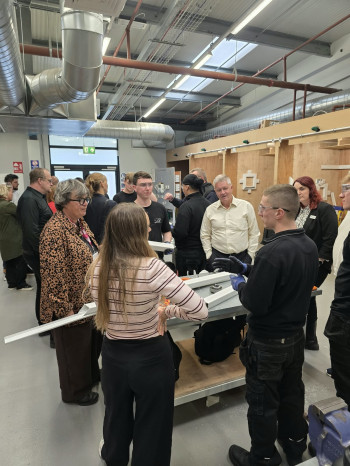 SUL received a request from the Scottish Government Directorate for Culture and External Affairs to host a session on trade union engagement across apprenticeships for a group of Swedish local officials, business owners and trade union officials.
SUL organised a site visit to the City Building Training College in Springburn, to provide the delegation with the opportunity to tour the facilities and hear directly from apprentices and tutors about their experience of Scottish Apprenticeships.
Lesley Quinn, Divisional Director of Corporate, Governance and Performance at City Building welcomed the delegation to the College. Lynsey Chambers, Training College Manager, City Building then presented on the importance of a holistic approach to well-developed apprenticeships.
Following the tour, presentations were delivered by Tommy Breslin, SUL Director, Dan Henderson, RMT Learning Organiser and Thomas Glavin, Chairperson of the Joint Trades Union Committee at City Building.
Dan Henderson said ‘The invitation to meet with the Swedish group was a fantastic opportunity for RMT to highlight our work with CalMac as an employer of young maritime apprentices from rural communities across the west coast of Scotland.
Poetry Masterclass for Journalists, with Alan Spence
 Learning Fund Case Study: National Union of Journalists (NUJ) - Highlands and Islands
When compared to training that teaches digital or industrial skills, a poetry masterclass may seem like an esoteric luxury. Yet, for writers, there is so much to learn from poetry that will improve general writing skills and cut across writing genres: the ability to distil complex ideas into few words; the focus on effective imagery; and not least the ability to capture strong emotion in writing, what the Romantic poet Wordsworth called, ‘the spontaneous overflow of powerful feelings.’ All of this was illustrated by multi-award-winning writer, Alan Spence, who delivered both a Book Week session in haiku and a poetry masterclass for the NUJ.
Countdown to Dyslexia Awareness Week with upcoming Dyslexia Scotland events
 Ahead of Dyslexia Awareness Week (28th September - 4th October), we’ve gathered the latest upcoming events hosted by Dyslexia Scotland.
Details for each listing, alongside additional scheduled activities, are available on the Dyslexia Scotland Events Page.
You can also sign up for their newsletter to get future updates and event details delivered straight to your inbox.
Order your free Blue Ribbons here to help to promote Dyslexia Awareness.
Dyslexia Scotland courses through OpenLearn Create
Three linked courses written by the Addressing Dyslexia Toolkit and Dyslexia Scotland with the support of the Opening Educational Practices in Scotland Project. All three courses use the General Teaching Council Scotland’s focus areas identified to support professional learning. It is recommended that the courses are complete in their intended order.
1. Introduction to Dyslexia and Inclusive Practice
Collaborative Artwork Description: an audio description workshop for artists
Learning Fund Case Study: Scottish Artists Union (SAU) - Highlands and Islands
 The Scottish Artists Union Highlands and Islands learning project delivered ‘Collaborative Artwork Description: an audio description workshop for artists’ as a two-hour online workshop in August 2025.
Guided by blind writer, poet, and researcher Joseph Rizzo-Naudi, participants explored collaborative, blindness-led approaches to beholding, describing, and communicating artworks. The course developed learners’ knowledge of disabled-led art practice and accessible approaches, equipping them with the tools to reach a wider audience and commit to inclusive art practice by being able to provide their audience with audio descriptions of their artworks, installations and exhibitions. This learning had the added benefit of improving employability and relationships with potential employers, as galleries and arts organisations must provide inclusive and accessible exhibitions in line with equality, diversity, and inclusion policies.
 RSS
